
How to Manage a Child with Challenging Behaviour: A Guide
When parents search for advice on how to support a child who shows challenging behaviour, they are often doing so from a place of worry, exhaustion, or concern for their child’s well-being.
Managing behaviour that feels intense or unpredictable can have a huge impact on family life and the child themselves, so it’s only natural to seek ways to support your child.
At Draig Behaviour Consultancy, we offer effective and affordable behavioural solutions to help parents understand and create strategies to improve their child’s behaviour. In this guide, we’ll explore what challenging behaviour looks like in a child and share practical, evidence-based strategies for managing your child’s behaviour.
What Is Challenging Behaviour in a Child?
Challenging behaviour that a child may exhibit includes aggression, withdrawal, refusal, self-injury, or intense emotional responses. While it may seem like these behaviours occur randomly and out of nowhere, there is always a cause.

Challenging behaviour, now known as behaviours of concern, includes actions such as aggression, withdrawal, refusal, self-injury, or intense emotional responses.
Your child isn’t choosing to be difficult. In fact, the way we talk about a child’s behaviour has changed to emphasise this.
Nowadays, the term 'behaviours of concern' has superseded the term 'challenging behaviour'. It reflects that the intention behind the behaviour is not to be challenging but to meet an unmet need. As behaviour is contextual, what often makes behaviours of concern 'challenging' is the frequency, severity, or location of the behaviour rather than the behaviour itself.
How to Deal With Challenging Child Behaviour: What Actually Helps
Now that you’re familiar with what behaviours of concern look like, let’s explore the 4 steps to help you deal with your child’s behaviour.
1. Rule Out Pain & Medical Causes First
We have to start by figuring out the cause of a child’s behaviour, and pain or medical problems should always be considered first.
This is partly because treating a medical condition often leads to faster behaviour change than behavioural interventions, and partly because no behavioural intervention will be effective if the child remains in pain, as we won't have met the unmet need.
For instance, if a child is hitting their head or engaging in behaviours that result in escape from environments with bright lighting, we might consider that they could be experiencing a migraine.
Seeking medical advice is always the best place to start. This is particularly the case if there is no obvious trigger for the behaviour, as it suggests the trigger is something we cannot see, such as pain or another form of sensory input.
2. Identify the Function of the Behaviour
Once pain is ruled out, the key thing to understand when supporting children who show behaviours of concern is their function.
All behaviour is functional, meaning it happens for a reason, typically because the child has an unmet need that they have no better way of communicating.
It’s important for us to understand why the behaviour is occurring before we can do anything to change it.
The 4 Functions of Behaviour
Behaviours of concern occur for four main reasons, called the four functions of behaviour:
To meet a sensory need, such as seeking out or avoiding noise, light, movement, or touch, when their sensory system feels overwhelmed or under-stimulated.
To access a tangible item or activity, such as trying to gain access to a specific toy or device.
To obtain interaction, connection, attention, or reassurance from others, especially if they have learned that certain behaviours reliably result in interaction.
To escape from difficult tasks or environments that feel too challenging, unpredictable, or distressing for them to cope with at that moment.
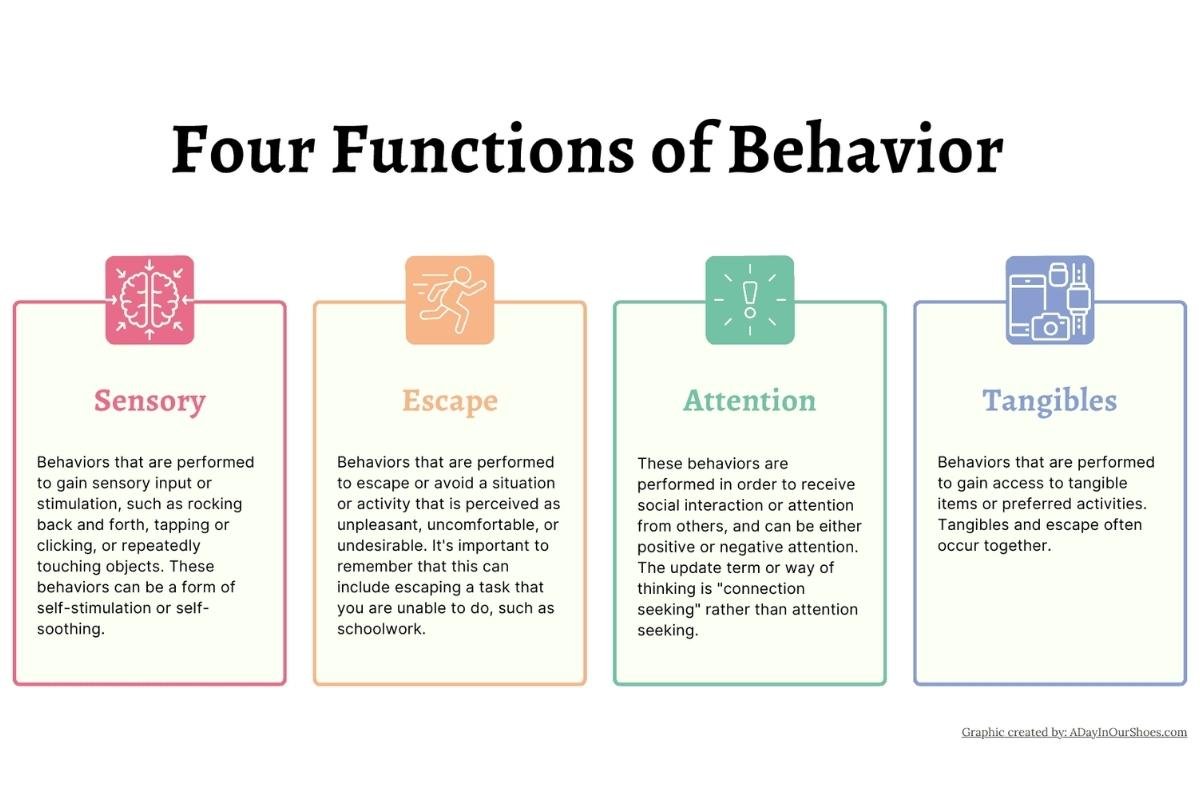
All behaviour has a cause that needs to be understood before change can happen, with research summarising behaviour as having four main functions: sensory, escape, attention and tangibles.
We recommend that a parent begin by examining what happens immediately before and after the behaviour to determine which function best explains why it occurs.
For example, if a child asks for their iPad, the parent says "no", and the child hits them, which results in the parent giving them the iPad, accessing a tangible item (the iPad) is clearly the function of the hitting.
It’s crucial to note that for children who experience the world differently, such as those who are neurodiverse or children who have backgrounds of adverse childhood experiences, environments that can appear routine or trivial may result in high levels of distress.
3. Change What Happens Before the Behaviour
When thinking about how to support a child who shows challenging behaviour, changing what happens before the behaviour is often the most effective place to start, as it'll often result in the quickest change in behaviour.
If the child's needs have been identified and met, the behaviour reduces very quickly, because there is no longer a reason for the behaviour to occur.
In the example with the child and the iPad, saying "no" can be less of a trigger if we help the child understand when it will become available, tell them what they need to do first before accessing it, and/or give a reason why it's not available right now. This will significantly reduce the likelihood of an aggressive response.
If you’d like specialist support with identifying a suitable proactive/preventative strategy to help your child, get started with our support for parents today.
4. Teach Skills to Replace the Behaviour
Another way to change behaviour is through changing what happens after it.
Sometimes behaviour continues because the child doesn’t yet have the skills they need. For the child with the iPad, for example, they might really struggle with waiting for something that they want, and we might need to teach this skill.

Supporting skill development can reduce distress and behaviour over time by providing the child with an alternative, more effective way of communicating.
Similarly, children with difficulties in their communication may communicate by using challenging behaviour. In these contexts, children can be taught to use alternative methods of communication such as PECS or Makaton.
For a child with communication difficulties who has learned that hitting is an effective way to encourage their parent to offer a variety of activities until the correct one is found, a clearer, more effective way to communicate exactly what they want will reduce challenging behaviour.
Do You Need Specialist Support?
We hope this guide has helped you understand the possible causes of your child’s behaviours of concern and given you some actionable strategies to support them.
However, reading this guide may not have been enough for you to make lasting changes, and specialist input can be really handy in many of the situations we discussed.
If you're unable to identify the function of the behaviour, the strategies you've implemented aren't working, you can't identify a suitable proactive/preventative strategy, or if you've identified a skills deficit but don't know how to teach it, we’re here to help.
At Draig Behaviour Consultancy, we have 10+ years of experience working with children within behaviour specialist roles in specialist education, NHS, and private residential care environments.
Get started with us today, and we’ll provide the right support so your child can learn safer, more effective ways to express themselves.
